Readiness Is All You Need
How reading comprehension became the most underrated skill in the AI era

In 2017, a group of researchers at Google published a paper called "Attention Is All You Need." It introduced the Transformer architecture, kicked off the era of large language models, and changed everything we know about software, work, and productivity. Nine years later, I find the title almost funny. The technology born from "attention" now demands something we have neglected for years: knowing how to read.
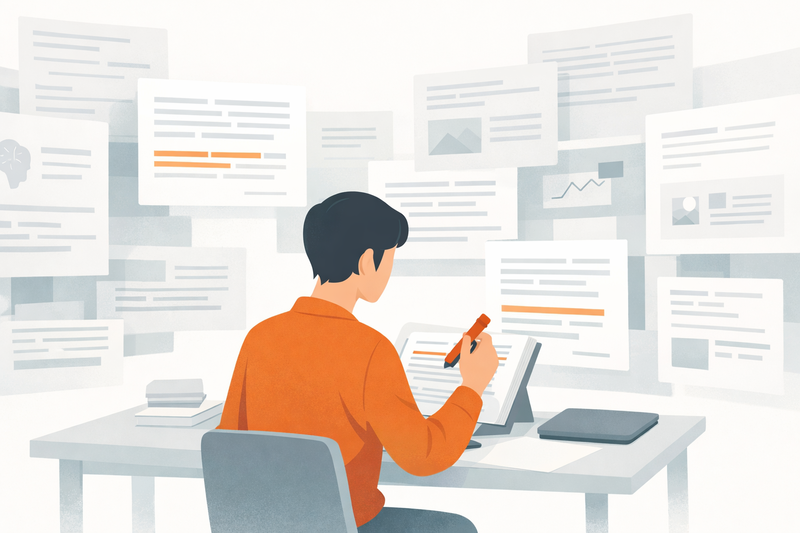
I spend most of my workday reading. Not books, not articles. AI output. I open ClaudCode, and it generates a 200-line execution plan for a feature I described in two sentences. I ask ChatGPT to research a topic, and it returns a full document with sources, comparisons, and analysis. Every interaction follows the same loop: I read, I interpret, I decide what matters, and I ask again. The faster I read without losing information, the better my next question becomes. Most of my value comes not from what I type, but from how well I process what comes back.
Everyone talks about prompt engineering, about how to write the perfect input. Nobody talks about the other side: output reading. And that is where AI is actually won or lost.
The text explosion nobody anticipated
Two years ago, working with AI meant typing a question and getting a paragraph back. Maybe two. The interaction was short, contained, manageable. That world is gone.
The AI agent boom of 2025 and 2026 changed the scale completely. Claude Code, Cursor, and Devin generate entire implementation roadmaps. ChatGPT produces full research documents, legal drafts, financial analyses. The output went from a few sentences to thousands of words per interaction. And we're expected to process all of it, evaluate it, and act on it. Multiple times a day.
Microsoft telemetry from 2025 showed that employees are interrupted 275 times a day by meetings, emails, and notifications. That was already a problem. AI didn't solve it. It added another layer: now, between those 275 interruptions, you also need to read and evaluate pages of AI-generated content. What was already an overload became an avalanche.
Steve Yegge observed in a recent podcast that "five paragraphs is already a lot to read for many devs." Five paragraphs. That's roughly what a single AI response contains. He was talking about developers, people who read code and documentation for a living. If five paragraphs is too much for them, consider what that means for every other profession now relying on AI daily.
The reading volume AI demands today simply didn't exist two years ago. Most professionals haven't adapted to it. And the ones who have are pulling ahead in ways that are hard to measure but impossible to ignore.
The invisible gap
A 2025 report from The Conversation found that 75% of knowledge workers already use AI tools, reporting an average productivity boost of 66%. Those numbers sound great until you look closer. That productivity is not evenly distributed. Not even close.
The difference isn't who has access to AI. Everyone does. A ChatGPT subscription costs $20 a month. Claude is free to try. Cursor has a free tier. Access isn't the problem. What happens after the AI responds is.
A professional who reads critically detects when the model is guessing. They notice when the structure looks right but the substance is thin, when they need to push for more depth. Someone who doesn't just hits accept and moves on. And here is the thing: from the outside, both look equally productive. Both typed a prompt, both got an answer, both moved to the next task. The difference only shows up later, when one person's work holds up and the other's falls apart.
I see this every day in software. When an AI agent generates an execution plan for a new feature, the plan always looks reasonable. Clean structure, sensible steps, professional language. But reading it carefully is the difference between building something solid and shipping a flaky implementation that ignores edge cases and creates technical debt from day one.
We learned this the hard way on a recent project. We moved fast, trusting AI execution plans without reading them thoroughly, without questioning the steps or testing the assumptions. It felt productive. It was not. We ended up slower because we had to go back and fix things that a careful read would have caught upfront. My colleague put it simply: "We are spending more time fixing than we would have spent reading."
Around the same time, a client shared an AI-generated technical plan for a project they wanted us to build. It was long, detailed, and looked comprehensive. But we did not read it carefully enough to extract what actually mattered, to form our own point of view on the architecture and the right way to build it. We just accepted the structure and started working. That cost us weeks of rework that could have been a few hours of critical reading.
The 2025 State of AI Literacy Report from CertLibrary captured it perfectly: "Someone can generate polished-looking outputs all day and still have weak AI literacy if they do not know when the model is guessing."
Same tools, same access, completely different outcomes. And the gap keeps growing.
We already knew how to do this, and we're forgetting
Reading comprehension. The thing we were taught since age 5. Book reports, reading assignments, comprehension tests. For decades it felt like a baseline, an assumed competency, the kind of thing nobody lists on a resume.
But for centuries, critical reading was the foundation of professional life. Lawyers read contracts line by line before signing anything. Doctors read clinical notes before seeing a patient. Engineers read structural reports before approving a build. Nobody shipped a bridge without reading the specs. Nobody closed a deal without reading the fine print. It was not a special skill. It was a professional duty.
And now, precisely when reading matters more than ever, we are doing it less. AI gives us polished, confident-sounding output, and we accept it at face value.
The consequences are already showing up in court, literally. Damien Charlotin, a researcher at HEC Paris, maintains a database tracking cases where AI hallucinations made it into legal filings. As of 2025: 486 cases worldwide, 128 lawyers sanctioned for submitting fabricated citations they never bothered to verify. One attorney in California was fined $10,000 after 21 of 23 quotes in his brief turned out to be invented by ChatGPT. Twenty-one out of twenty-three. These weren't bad lawyers. They were busy professionals who stopped doing the one thing their job requires: reading what's in front of them.
Think about that for a second. We treat AI like a trusted senior colleague when it is closer to a very talented intern who sometimes makes things up. The same professionals who would never sign a contract without reading it are now shipping AI-generated code, sending AI-drafted emails, and present AI-written reports without actually reading them. It is alarming when you say it out loud.
Meanwhile, the entire industry focused on the wrong side of the equation: prompt engineering. There are courses, certifications, entire frameworks dedicated to writing better inputs. But the reality of working with AI is that 80% of your time is reading, not writing. The real loop is: read, interpret, ask better, read again. The quality of your next prompt depends entirely on how well you read the previous output.
Yegge worries that chat-oriented programming "isn't for the masses" precisely because of reading limitations. He predicts most people will eventually program by talking to a visual avatar instead of reading terminal output, because the text volume is simply too much. I think he is right about the problem and wrong about the solution. The answer is not to remove the reading. It is to get better at it.
We did not need a new skill. We needed to keep the one we already had.
This isn't just a developer problem
I used developer examples because that is my world. But I keep thinking about what this looks like in other fields.
Take law. AI can now draft a merger agreement that reads like a senior associate wrote it. Clean prose, proper clause structure, professional tone. But what if buried in section 7, it introduced language that shifts liability in a way nobody negotiated? A partner with 20 years of contract work would catch that in a skim. But how many junior lawyers are even reading the full output before sending it to the client? Charlotin's database of 486 sanctioned cases suggests the answer is: not enough.
Marketing has a different version of the same problem. You ask AI for ten ad copy variants and get ten pieces that are all technically fine. The real skill is nott generating them. It is reading all ten and knowing which one actually sounds like your brand versus which nine sound like every other brand. That requires editorial judgment you can only apply if you actually read closely, not just scan for the one that "feels right."
And then there is finance, where the stakes become scary. AI-generated quarterly reports look clean; the charts are formatted, and the executive summary reads well. But if the model extrapolated a trend from incomplete data, the only way to catch it is to read the methodology section, not just the conclusions. Most people skip that part even when a human wrote it.
The skill underneath all of this is the same one we have been talking about. Reading with judgment. The specifics change by industry, but the muscle is identical.
Don't lose the good habits
We built civilization on reading. Contracts, laws, science, medicine, all of it depended on people who read carefully before they acted. That habit wasn't glamorous, but it was load-bearing. And now we are dropping it.
AI is the most powerful tool we have had access to as professionals. But it is also the easiest way to stop thinking. Every time you accept an output without reading it, you are not saving time; you are accumulating risk. Every time you skip the verification step your profession was built on, you erode the foundation that made your judgment valuable in the first place.
The answer isn't some new AI literacy framework or a certification in prompt engineering. It's simpler and harder than that: don't lose the good habits. Read what's in front of you. Question what sounds too clean. Verify before you ship, send, or present. The same discipline your profession demanded before AI still applies. It just matters more now.
If I had to distill this into a few takeaways:
1. AI did not reduce the need to read; it multiplied it.
2. The gap between those who read well and those who do not is widening, and nobody is measuring it.
3. Real prompt engineering starts with reading the output, not writing the input.
4. We do not need a new skill. We need to stop losing the one we already have.
In 2017, a group of researchers at Google published a paper that changed everything. They called it "Attention Is All You Need." Nine years later, the technology born from attention now demands something we've always had but are choosing to forget. Readiness is all you need. And readiness starts, as it always has, with knowing how to read.

Comments
No comments yet. Be the first to comment!